Monday, August 31, 2015

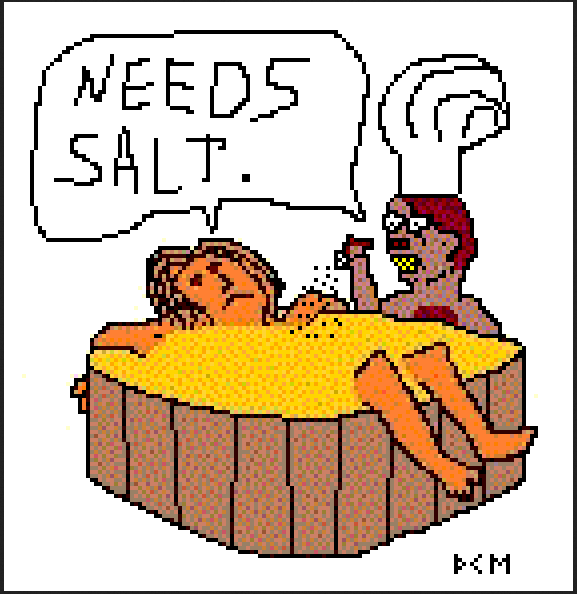
Owl Bear Egg Frittata


γαστήρ – “gaster” the stomach
νόμος, - “nomos” laws

A gastronome is not a gnomish airship pilot but a scholar of the preparation, consumption and cultural significance of food. Several of my players (and me) are borderline if not outright gastronomes. Some may refer to the inclination by the more modern term, “foodie”, but I feel the spirit of the interest goes beyond just food in and of itself. “Foodie” has a pejorative tone, and also a connotation of gluttony or snobbery in regards to the consumption of food. We gastronomes are as interested in the cultivation, preparation, and social settings of food as in the act of eating.

What does this mean at the D&D table? We play “virtually” so we cannot actually share a snack or meal in person (although we do often show off an amazing variety of snacks, from freeze pops to giant Peruvian Inca corn.) We can however explore the gastronomic realm in game.  In Lasers & Loincloths we have hunted dinosaurs for a well-paying chef’s dreams of meat sculpture. One of the characters joined the party after being rescued from marinating in the stew pot of Ape-Men. Chili, tortillas, and ambitions to own a restaurant often drive The Last Pale Light in the West. In the 3LBB OD&D game we meticulously track food and water consumption while trapped in a dungeon, and thus have eaten all manner of things not really meant to be eaten.

jesh.PNG

Aside from food as motivation for player actions and fodder for adventures in game, I have created and adopted some mechanics for food and drink in D&D. From the widely used house rule of gaining 1d3 HP from a swig of strong drink, to a cooked meal increasing a character's healing rate while resting. We also have rules for what happens when you eat that which was not meant to be eaten in OD&D (hint: mutation charts)  I want to do more though; my players and I lap this stuff up. I do not use distinct skill systems in D&D, so a cooking or eating skill is not appropriate. I do like using experience point mechanics as a driver for the tone and intentions of a D&D game, and thus I will add the following to Lasers & Loincloths.

Cooking XP
Experience points are awarded for cooking and serving exemplary meals prepared with rare or precious ingredients.

To butcher or remove an ingredient requires a WIS check and sometimes a saving throw.
Ingredients are worth a number of d6 based on rarity or value.  For example, a bucket of screaming eels would be worth 1d6 (unless it they were caught during scream season in which they would be worth more) while the iridescent liver of a shoggoth from Ghooric Space would be worth 10d6. Total the roll to determine the ingredient number.

Adding mundane ingredients to a dish adds 1 to this number (common vegetables, spices , starches etc.)

Cooking Techniques are rated via a dice type that increases based on the difficulty of the technique.

Cooking Technique
Dice Value
Boiling
1
Grilling / Broiling
1d2
Frying / Sautéing
1d3
Baking / Roasting
1d4
Stewing/Simmering
1d6
Potting /Tandoor
1d8
Smoking
1d10
Engastration
1d20

Most cooking techniques require appropriate tools (frying pans, heat, clay pots etc.)

To determine the XP value of a dish, multiply the ingredient roll by the technique roll. In order to gain this XP, the cook must share the dish (and the XP) with at least one other person.

Thursday, August 13, 2015

Poison'd! Play Report I.


Somehow our buckles were all independently getting swashed, a random question about the Blackbeard boardgame, a comment about a book on pirates … Coming back from vacation I decided it was time to finally run Poison’d by Vincent Baker.


We dally with “story games” (The Few, A Quiet Year, 3:16) but my group is really a meat and potatoes Lovecraft + D&D + plasma rifles kinda scene. Fortunately we are all experienced role players with vivid imaginations (or perhaps drug addled brains) and are willing to try most games.


So, without further rambling here is our Poison’d play session:


The Setting


The Caribbean Sea in the year 1701. The European powers are on the brink of the first global war. A conflict that will pit Spain and France against England, Holland, and the Holy Roman Empire, it will be known as Queen Anne’s War in North America and the War of The Spanish Succession elsewhere. The Caribbean is the very edge of “civilization” a place where an individual can defy the old order by violence and force of will. It is a festering pool of national rivalry, brutal slave driven capitalism, and lawless freebooting.


Despite the burgeoning field of science and the European move towards the Enlightenment, this is a world where Heaven and Hell are very real and the souls of men are at stake in the eternal struggle between God and the Devil. The restless spirits of the damned can haunt the living, and idolatrous practitioners of the old heathen ways call curses down on their foes.  


The Cast


the players.PNG


Mike as John “Davy” Douglas The Sailing Master  former Royal Navy Sailing Master/ Pilot now confederate and chum of the pirate Captain Brimstone Jack


Tim as Zuberi The Boatswain.  A polyglot Shona from Portuguese Mozambique. Zubari was brutalized by Captain Jack but turned his anger to keeping Brimstones Jack's crew in line as a sadistic boatswain.


Drew as Pascal the Ship's Surgeon a French Physician kidnapped by pirates and put to work as the surgeon of The Dagger.


Travis as Cuthbert Robinson The Ship's’ Boy. The young son of the Governor of Bermuda, kidnapped by Brimstone Jack. When the Governor refused to pay a ransom, Cuthbert joined the pirates and swore vengeance on his father.


dagger 2.jpg


The Dagger A ship rigged two masted Bermuda Sloop. She isn’t and old ship but was used hard and ill-treated by Brimstone Jack. She was fitted out with much twice laid stuff, and her sails and rigging in particular are a sorry state.  She has a diverse, and bloodthirsty crew of 110 damned souls. She carries a battery of 20 guns, fourteen six pounders and six eight pounders.


The Situation


set up.PNG
  • Introduction from Poison’d by D. Vincent Baker


The Play


John Davy Douglas wasted no time at all and threw the traitorous cook overboard where he was quickly devoured by the ravenous tiger sharks that shadow The Dagger. Facing the crew he proclaimed himself the new Captain. Cuthbert Robinson the ship's boy and an educated gentleman also stepped forward to seize command. Each of them had a quarter of the crew behind them, leaving the decision in the hands of the other players. Pascal, despite his friendship with Cuthbert with whom he was imprisoned by Brimstone Jack, threw in his (and a quarter of the crews) lot with the more experienced Douglas. This left the decision in the hands of the African Zuberi. Zuberi also had ambitions to become captain of The Dagger, but decided to abandon his ambition and made a bargain with Davy Douglas securing two shares of loot in exchange for his support. Once it was clear that the majority of the crew supported Douglas, Cuthbert backed down, and abandoned his ambition to become captain.


Now with The Dagger short on supplies, badly in need of careening, and being pursued by the HMS Resolute the newly christened Captain Davy Douglas decided to gather supplies at a remote fishing village on the north coast of Puerto Rico. The pirates quickly seized the town and captured fresh food and water. Pascal the French physician wandered off to the jungle and acquired two doses of hallucinogenic herbs. While the ship sailed for shelter at Turtle Cay near the friendly Danish port of Charlotte Amalie in order to careen, Cuthbert swallowed a dose of the herb. He went to the captain’s cabin to persuade Davy Douglas to heed his advice on running the ship but instead hallucinated that Davy was his father the Governor of Bermuda, who abandoned him. Davy played along, and eventually talked Cuthbert down.


The Dagger arrived at Turtle Cay, and the crew began the arduous task of beaching and careening the ship. On the second day, the HMS Resolute heaved to at the top of the lagoon, blockading The Dagger as she lay helpless on the beach.


careening.jpg


Captain Rutherford of Her Majesty’s Navy sent his Lieutenant on a launch to negotiate the terms of the pirates surrender since they were so obviously bested. Little did the Royal Navy know, the Pirates had cleverly mounted shore batteries to cover the lagoon. Captain Davy Douglas, who secretly had a bargain with Captain Rutherford to deliver The Dagger to the Royal Navy, ordered Zuberi to take The Daggers longboat and meet the Lieutenant and then commanded Cuthbert and Pascal to man the batteries. After he issued commands, he washed his hands of the action cleverly avoiding breaking his bargain with Captain Rutherford. When the two boats approached each other in the lagoon, the young naval lieutenant called for the pirates surrender. Zuberi replied by blowing His Majesty's officers brains out with a long pistol shot. The Pirates on the long boat fired a devastating volley at the navy launch murdering the launches crew. At the same time, Pascal and Cuthbert opened up on the Resolute with the six and eight pound ships guns from The Dagger that had been hidden on the shore. Surprised by the sudden violence, Captain Rutherford backed the Resolute, and sailed away from Turtle Cay.
Having driven off the navy for now, the crew finished careening the ship. Grumbling that Captain Davy Douglas had done nothing but drive them hard and almost get caught by the King's agents the men began clamoring for a prize. Captain Davy concurred, and set The Dagger northwest to cruise off Puerto Rico for booty. After a few days looking for a suitable prize, they spied a Spanish Xebec and gave chase. As they closed, The Dagger broke out the Black Flag, and the Xebec surrendered requesting mercy. The pirates acquired modest loot; the Spanish were carrying cochineal and mercury bound for Vera Cruz. Captain Davy ordered the Xebec scuttled, and The Dagger cruised on looking for further booty.


xebec1.jpg


Their next victim was a Spanish galleon, out of San Juan for Spain carrying cotton and tobacco. The galleon put up a token resistance, but while trying to flee ran aground on a reef and her crew broke when The Dagger’s fierce and well-armed cutthroats swarmed aboard. The captain of the Galleon, a veteran Spanish caballero emerged from his cabin wearing breastplate and showing cold steel. Zuberi bravely squared off against the man. Scimitar versus Toledo long sword and main gauche, the fight raged back and forth. The Spaniard gravely wounded the African, but rather than surrender Zuberi pressed his luck, staking his life on a vicious attack that gutted the old gentleman and left him dead on the deck of captured galleon. Pascal tended to Zuberi’s wound, but the African suffered from the treatment gaining a hideous scar.
The operation on Zuberi put Pascal into a reverie in which he recalled escaping his imprisonment by Brimstone Jack. Two years earlier, Jack and The Dagger captured an English barque carrying Pascal and Cuthbert Robinson the son of the Governor of Bermuda.  When the Governor refused to pay a ransom, Jack imprisoned both the physician and the boy in a cramped chest. Weeks of torturous confinement passed, during which Pascal and Cuthbert bonded in suffering and madness. Finally one night Pip, Jack’s steward and the ship’s boy, forgot to lock the chest after he delivered the meager scraps that sustained the prisoners. As Pip helped himself to the Captains liquor Pascal emerged from the chest with a hidden lancet grasped in his pale hand. Pip never saw the cold gleam in Pascal’s eye as the physician slit his throat from behind with the calm practiced movements of a surgeon. Pascal and Cuthbert escaped the confinement of the chest, but were still on The Dagger. They did not escape the hell of spiritual anguish, as they no longer had the will to resist joining the pirates. It was not long thereafter that they threw in their lot with the damned.


thumblancetandfleam1.jpg


After the capture of the Spanish galleon, a fog descended obscuring the horizon. As The Dagger groped blindly for direction the HMS Resolute appeared out of the shrouded seas. Not yet ready to confront their pursuers the pirates ran, Captain Davy pushed the ship hard. The fog helped, and with an impressive effort from the crew and ships officers The Dagger attempted an escape. As they were slipping from his grasp Captain Rutherford of the Resolute used his bargain with Davy Douglas and attempted to call in his debt hindering Davy’s soul which reduced the vitality of the Captain's efforts. Despite the spiritual blackmail The Dagger still made good the escape, freeing Douglas from his burden to Rutherford.

1260980397se9j2lP.jpg


After escaping the HMS Resolute again, at the suggestion of Cuthbert The Dagger sailed south to raid the Spanish Main. During the voyage, Zuberi decides to take vengeance on Richard Book the quartermaster of The Dagger. A man who was a close confederate of Brimstone Jack, and inflicted particular cruelty on Zuberi before the African became the boatswain. He convinced the other ships officers to be his accomplices, and Captain Davy who was an old companion of Book, knew the best time for Zuberi strike. The quartermaster would spend the next night drinking himself to a stupor to commemorate the anniversary of his late wife’s death.  Once he was drunk, Zuberi seized him and drug him up to the main top gallant, bound him to the mast and cut off his head. Flinging the head down to the deck Zuberi warned the crew that the old ways of Brimstone Jack are done, and the Captain Davy Douglas is now truly in charge. The murder of Richard Book done, Zuberi’s ambition of vengeance was accomplished.


The Dagger continued south and spoke to a Carib canoe west of Guadeloupe. The pirates bought fruit and fish from the natives and learned of a Spanish treasure ship at anchor in the harbor of Margarita. Seizing the opportunity the pirates bring The Dagger to a position just out of site of the harbor and at night Zuberi led the longboat in to reconnoiter the ship. The Spanish treasure ship was moored close to the guns of the fortress of Santa Rosa with what appeared to be a minimal crew. They decided that Zuberi and Cuthbert would lead a cutting out party under cover of The Dagger attacking the fort at long range. Sneaking aboard the Spanish ship, Cuthbert and Zuberi slit the throats of the sentries on deck. They entered the captain’s quarters and after they murdered the man discovered that the ship was quarantined with plague. The boarding party who went below decks encountered a sleeping and plague ridden crew. The pirates decided to burn the ship taking the single chest of silver bullion from the captain's quarters. As they fired the vessel, the Spanish crew emerged roused by the flames. They carried the remainder of  the ship's treasure of Andean silver. Zuberi and Cuthbert decide to risk the plague, and ordered the boarding party to attack. As the treasure ship burned around them, the pirates cut down the sick Spaniards and relieved them of the silver. Then they boarded the longboat the set off back to The Dagger.


Castillo_de_San_Carlos_de_Borromeo_(Pampatar,_Isla_de_Margarita).JPG


Captain Davy Douglas meanwhile had been engaged in a long range duel with the fort. The well laid and quickly served eight pound guns of the Pirates reduced the fort and set it ablaze. The Spaniards eventually struck their colors. Pascal watched the burning treasure ship with apprehension, suspecting that something had gone very wrong with the plan to cut it out of the harbor. As the longboat came alongside The Dagger, his suspicions were confirmed when he heard the boats crews speaking in terrified whispers of the plague. Pascal bravely descended into the boat, and examined the men including an unwilling Cuthbert and Zuberi. He decided they had not been exposed and allowed them back onto The Dagger. The Pirates then landed another party to sack the fort, gaining valuable powder, shot, and small arms. Leaving behind a smoking ruin, The Dagger then sailed into the night.


In which direction will the salty crew of The Dagger sail next?
Will they continue along the Spanish Main taking the treasures of the new world by violence and perfidy? Will they split up their loot and scatter to the wind? Will they sail for Bermuda to fulfill ambitions of vengeance? Or will they all meet damnation at the hands of the stalwart Captain Rutherford of the HMS Resolute?

Monday, June 22, 2015

Squinting at the Last Pale Light


Last year, inspired by among other things, Cormac McCarthy’s Blood Meridian I decided I wanted to run a western game. I read Boot Hill 1st and 2nd editions, Aces & Eights, Dogs in the Vineyard and Dust Devils. All of these games are awesome in their own way, but none of them were a perfect match for my table. Then I found Blood and Bullets by Simon Washbourne at Beyond Belief Games. http://beyondbeliefgames.webs.com/freestuff.htm


We were already playing a version of Swords & Wizardry and I am idiotically obsessed with old school D&D so I decided to steal some of the ideas of the other western games and cram them into the framework of Swords & Wizardry/Blood and Bullets. Interestingly at the same time I became aware of the 5th edition D&D advantage/disadvantage mechanic so I tossed that into the pot too.


The result is a spicy chili of the sometime incongruous elements of D&D red beans and Story Game vidalia onions. I called it The Last Pale Light In the West and it was a hoot. We made deals with the devil, had duels at high noon, got married, blew shit up, and hung the sheriff.


I want to get back to it.


So, I have been reexamining the rules. I am moving it a little closer to 5th edition in terms of combat and skill resolution, while at the same time bringing player narrative control and character development to the foreground. The game is gawdamn freak, but it’s an amusing freak.


One aspect is being re-written entirely. D&D’s Hit Point combat system doesn’t work well for mano a mano gun duels. Towards the end of the last campaign I was experimenting with a dueling system that did away with hit points. I’ve thought up something along similar lines that uses playing cards.


Here we go.


card duel.jpg


Duels
Duels do not use standard combat rules.


Each duelist draws a number of playing cards equal to proficiency bonus + dexterity modifier + number of duels won.
The challenger then names the stakes; graze, wound, or death.
The other duelist may either see the stakes, raise, or fold. Each tier raised allows both duelists to draw another card.
The best 5 card poker hand wins the duel.


The loser must make a CON Save (1d20+ CON bonus+ proficiency bonus) vs DC 15. Success means they suffer the effects of one tier less than the agreed stakes (death becomes a wound, a wound becomes a graze, a graze becomes a near miss such as a hat/belt being shot off) Failure means they suffer the effects of the stakes.


> Graze - Take 1d6 non exploding dice damage
>Wound - Lose half your hit points and you are wounded
> Death – You are dead


After the duel cards have been revealed, the duel is considered complete and the winner is declared. Any further combat is resolved using the normal combat procedure.


The winner of a duel records the win on their character sheet, and gains 100 XP per hit die of foe defeated.

Tuesday, June 2, 2015

Adventure Games!

I run D&D combat without a grid. I have used a grid in the past but I now prefer the theater of the mind to tactical miniature combat for RPGs. (I am fond of tactical miniature combat, but those are different games altogether.) I find that using a grid for D&D narrows the focus of combat to what is represented on the table rather than what is happening in the imagination. This is fine if you are playing a wargame that strives for some sort of simulation, but D&D is an adventure game and should not be confused with simulation. I require only a modicum of “realism” in an RPG, especially D&D. For me, RPG rules should impose just enough limits on imagination to give fidelity to the system.
“Rulings not Rules” is a principle of old school play.  A principle I take to heart. The result of making repeated rulings however, tends to be a rule. In order to ease my job as a DM, and to give my players a solid foundation on which to build imaginary action I have codified a loose system for movement and action in D&D combat. The system is built on several assumptions that I draw from my interpretation of the OD&D rules, as well as lessons learned from years of running D&D combat. Sometimes my players, especially those accustomed to newer style combat question my rulings. This is fine; a rule that cannot be defended is no rule at all. The Lasers & Loincloths document outlines the combat round and its rules, but I think it’s important to look at the assumptions and interpretations that inform those rules:

1. Ease of play is more important than attempting a simulation of fantasy medieval combat.

2. I use the Gygaxian 1 minute combat round. This has significant ramifications.

3. Movement and position are abstract unless specifically defined in the fiction.

Let’s take a closer look at these assumptions.

Ease of play is more important than attempting a simulation of fantasy medieval combat.

This echoes what I stated earlier, D&D is an adventure game not a wargame.  Yes it has wargame roots, yes it can be played as a wargame but this is not how I play D&D. Setting aside the absurdness of simulating fantasy combat, there are much better wargames than D&D. To me D&D is at its best as a role playing adventure game where players assume the roles of fantasy characters on adventures.  Combat is certainly a part of this, it may even be the focus of a particular session or campaign, but there is much more to a good D&D game than combat. My sessions typically run 4-5 hours. Generally I want to run a complete “episode” in that time frame, with player choices, drama, in character role-playing, and if necessary a few combat encounters, all forming a contained story arc. When combat takes place, it should be exciting, which to me means quick and deadly. If a combat encounter takes longer than 30 minutes, it loses its excitement and gets in the way of creating the shared fiction that is the heart of the game. Effectively managing the players is a big part of keeping combat quick, but the actual mechanics of running a combat also contribute to its length. I strive to find the right balance between simplicity and creating the illusion of fantasy combat. When I must make a ruling I lean towards simplicity. Simple group initiative, three armor types, movement by range bands, weapon damage by HD, and one minute combat rounds are all tools I use to speed up combat and ease play.

I use the Gygaxian 1 minute combat round. This has significant ramifications.

One minute is an eternity in melee combat. During this time it can be assumed that combatants move up to their maximum rate while jockeying for position. They strike, feint, parry, circle, dodge, and may even land multiple blows. The attack roll represents all of this. It is as Gygax says in the 1st Edition DMG; “not in the best interest of an adventure game to delve too deeply into cut and thrust.” A combatant's skill, speed, stamina, morale, luck, ability to gain advantageous position, and other factors are all subsumed in the “to hit” roll and its modifiers. As is usual, the original game got it right;
“This system is based upon the defensive and offensive capabilities of the combatants; such things as speed, ferocity, and weaponry of the monster attacking are subsumed in the matrixes.” - Men and Magic Alternative Combat System Page 19.
It is difficult to break from the mental habit of imagining that rolling the d20 represents a single cut or thrust, but once we do combat becomes faster (more exciting) and to me at least much of the rest of the game makes more sense. The one minute round allows us to logically ignore the mechanical differences of weapons such as speed, reach, and variable damage. Once we scale the attack roll to incorporate the multiple facets of a melee rather than just an attack, weapon differences become less important than the skill of the wielder. Armor class as a reflection of the “heaviness” of armor also makes more sense. An opponent’s Armor AC does not represent the difficulty of landing a blow, but the armor's ability to turn a blow and how hard it is to strike in a place that is unprotected. During the course of a round we can imagine an opponent landing multiple blows on an armored area, or striking at and missing the vital chink in the armor. The hit point system is also more logical. Loss of hit points in a combat round reflects the wearing down of the defenses, stamina, morale, and luck. Only occasionally does loss of HP represent actual wounds, usually the last hit dice worth of hit points. (Incidentally this is what makes low level play so exciting.)
Rather than an attack roll representing one attempted “attack” with a weapon, the attack roll models an entire minute of the chaos of medieval combat.  Forgo imagining the single cut and thrust, and imagine instead an entire routine of movement, parries, and attacks. Zoom out the action, scale it up and the entire game goes smoother and makes more sense.

Movement and position are abstract unless specifically defined in the fiction

One of the implications of not using a grid for a one minute round is that we must assume combatants are moving but unless we are building a complex narrative, the tracking of actual position is troublesome.  I have found that verbally positioning combatants and trying to track positions with a mental map can be done, but it is generally not worth the effort. Considering this, I track movement by three range bands. Long range is the extreme range of a missile weapon, short range is outside of melee reach but not far enough to make missile fire more difficult. Melee range is too close to use a missile and within movement and striking range of a hand held weapon. I allow one action per round, a movement action can be used to change range bands, withdraw from melee, retreat from combat all together, or spend an entire minute maneuvering for an advantageous position in melee. An attack action also represents movement up to the combatant’s movement allowance, but this movement is within the current range band. All of this movement is abstract, we assume a melee combat is a whirl of adversaries coming within striking range, dodging, trying to flank, and attacking.
Only occasionally is position not abstract. Typically a position is specifically defined when an environmental feature influences the course of action. Normally this is a constraint, such as a door, narrow corridor, bridge, shoggoth pit, etc… Occasionally a position will be defined by advantage, such as a character swinging from a chandelier or other such feats of daring do. Once a position is defined I will consider things like opportunity and rear attacks, weapon size, and area of control. I find using abstract movement greatly eases play by generally eliminating the need to track movement rate and potion. It also helps to put everyone at the table on the same mental map without resorting to a grid.

D&D is a combat game, but it is not just a combat game.  I am not interested in the attempt to simulate something which would be pure conjecture (fantasy combat). I am interested in the creation of cool adventure tales, tales created at the table with my players and the dice. Combat is almost always a part of these tales, but I want it to be fun (quick and dangerous) and not monopolize an entire gaming session. The one minute combat round, and abstract movement help achieve these goals.

Fight on!